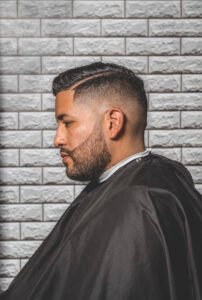
 Taper Fade Types: Every Variation Explained
“Taper fade” isn’t one haircut — it’s a family of them. The term covers a range of variations that differ by where the fade starts, how short it goes, and how it’s shaped around the ear and neckline. Asking for “a taper fade” without specifying which type is the most common reason people leave the barbershop with something they didn’t picture.
This guide breaks down every major taper fade type, what distinguishes each one, who it suits, and how to ask for the specific version you want.
In this guide:
- What a taper fade actually is
- Every major taper fade type, explained
- A comparison table of all variations
- Which type suits which hair type and face shape
- How to ask your barber for a specific taper fade type
- Maintenance by type
- FAQ
What Is a Taper Fade?
A taper fade is defined as a haircut where the hair at the sides and back gradually decreases in length moving downward, blended smoothly so there are no visible lines between lengths. It combines the gradual shortening of a taper with the blending technique of a fade.
The distinguishing feature across all taper fade types is the gradient — hair transitions progressively rather than jumping between distinct lengths. What varies between types is where that gradient starts on the head, how short it goes at the bottom, and what shape it follows around the ear and neckline.
A skin taper haircut is one specific variation within this family, where the shortest point goes all the way down to bare skin rather than stopping at a visible stubble length.
Taper Fade Types: The Complete List
1. Low taper fade
Starts just above the ears and follows the natural hairline around the back. The most subtle option, since the fade occupies only a small band at the very bottom of the sides.
Best for: Conservative workplaces, first-time fade clients, anyone wanting length preserved on the sides.
2. Mid taper fade
Begins around temple height, roughly halfway up the side of the head. The most balanced and broadly flattering option.
Best for: Most face shapes and hair types; the safest default choice.
3. High taper fade
Starts above the temple, closer to the crown, creating a strong contrast between the faded sides and the length on top.
Best for: Thicker hair, bolder looks, anyone wanting maximum visual separation between sides and top.
4. Skin taper (bald taper)
Any of the above heights, but taken all the way down to bare skin at the shortest point instead of stopping at a short guard length.
Best for: Sharp, high-contrast looks; requires the most frequent maintenance of any taper fade type.
5. Burst taper fade
Fades outward in a curved, semicircular shape around the ear rather than following a straight horizontal line, leaving the back of the neck longer.
Best for: Curly and textured hair, mohawk-adjacent styles, anyone wanting a rounder silhouette.
6. Drop taper fade
The fade line curves downward behind the ear, following the head’s natural shape rather than staying level.
Best for: Rounder head shapes, adding visual balance at the back.
7. Temple taper (temp fade)
Fades only around the temples and hairline, leaving the rest of the sides at a uniform longer length.
Best for: Minimal, subtle cleanup; often paired with curly or Afro-textured hair worn longer on top and sides.
8. Neckline taper
Tapers only at the back of the neck, leaving the sides largely untouched.
Best for: Maintaining a tidy back hairline on longer hairstyles without committing to faded sides.
Comparison Table: All Taper Fade Types
| Type | Where It Starts | Shortest Point | Contrast Level | Maintenance |
|---|---|---|---|---|
| Low taper fade | Just above ears | Short guard | Low | Every 4–5 weeks |
| Mid taper fade | Temple height | Short guard | Moderate | Every 3–4 weeks |
| High taper fade | Above temple | Short guard | High | Every 3 weeks |
| Skin taper | Varies | Bare skin | Very high | Every 2–3 weeks |
| Burst taper fade | Curves around ear | Short guard or skin | Moderate-high | Every 3–4 weeks |
| Drop taper fade | Curves behind ear | Short guard or skin | Moderate-high | Every 3–4 weeks |
| Temple taper | Temples only | Short guard | Low | Every 4–6 weeks |
| Neckline taper | Back of neck only | Short guard | Very low | Every 4–6 weeks |
Recommendation: The mid taper fade is the most versatile starting point across face shapes and hair types. If you want minimal upkeep, a low taper or temple taper stretches furthest between visits.
Choosing the Right Taper Fade Type
By hair type:
- Curly or coily hair often suits a burst taper fade or temple taper, both of which work with the hair’s natural shape rather than cutting straight across it.
- Straight, thick hair carries high and mid taper fades well, since the density supports strong contrast.
- Fine hair generally looks cleaner with a low or mid taper, where the gradient has more room to blend without looking abrupt.
By face shape:
- Round faces benefit from higher taper fade types, which add visual height.
- Long or narrow faces are usually better served by a low taper, which avoids adding extra vertical emphasis.
- Square faces work with most taper fade types, since the jawline already provides definition.
How to Ask for a Specific Taper Fade Type
- Name the height — Say “low,” “mid,” or “high” rather than just “taper fade.”
- Specify skin or guard — Clarify whether you want it taken down to bare skin (skin taper) or left at a short guard length.
- Mention the shape — If you want a burst or drop taper fade, say so specifically, since these follow different lines around the ear.
- Bring a reference photo — Terminology varies by shop and region, so a photo removes ambiguity that words alone can’t.
- Describe the top separately — The taper fade only describes the sides; the top length and style is a separate conversation.
Pro tip: If you’re unsure between types, ask your barber to start lower and go higher. A barber can always take a fade higher during the cut, but can’t add length back once it’s cut too high.
Common Mistakes
- Saying only “taper fade.” Without a height or shape specified, you’re leaving the interpretation entirely to the barber.
- Choosing a skin taper without accounting for upkeep. Skin tapers need touch-ups roughly twice as often as guard-length tapers.
- Picking a high taper fade with fine hair. The contrast can look harsher than intended against lower hair density.
- Confusing burst and drop tapers. Both curve, but a burst taper curves around the ear while a drop taper curves downward behind it — they produce noticeably different results.
Frequently Asked Questions
What are the different taper fade types? The main taper fade types are low, mid, high, skin taper, burst, drop, temple, and neckline tapers. They differ by where the fade begins on the head, how short the shortest point goes, and what shape the fade line follows around the ear and neck.
What’s the most popular taper fade type? The mid taper fade is generally the most widely requested because it balances contrast and versatility, working with most face shapes and hair types without requiring the frequent upkeep of a skin taper.
What is a skin taper haircut? A skin taper haircut is a taper fade taken all the way down to bare skin at its shortest point, rather than stopping at a short but visible guard length. It offers the highest contrast of any taper fade type and needs the most frequent touch-ups.
What’s the difference between a burst taper fade and a drop taper fade? A burst taper fade curves in a semicircle around the ear, leaving the back of the neck longer, while a drop taper fade curves downward behind the ear, following the head’s natural shape. Both are rounded rather than straight, but they shape different areas.
Which taper fade type is best for curly hair? Burst taper fades and temple tapers tend to suit curly hair best, since both follow the natural curve of the head rather than cutting a straight horizontal line that can look abrupt against curl texture.
How often do taper fades need touching up? Most taper fade types need attention every 3–5 weeks, though skin tapers typically need it every 2–3 weeks and minimal types like temple or neckline tapers can stretch to 6 weeks.
Is a taper fade suitable for a professional setting? Yes — low taper fades and temple tapers in particular offer a clean, conservative look that suits most professional environments without the strong contrast of higher or skin variations.
Can you combine taper fade types? Yes, barbers often combine elements, such as a mid taper fade with a drop line at the back, or a burst taper that goes down to skin. Describing the combination clearly or bringing a photo helps communicate what you want.
Key Takeaways
- “Taper fade” describes a family of cuts, not a single style — the main types differ by fade height, shortest length, and shape around the ear.
- The mid taper fade is the most broadly flattering default; low and temple tapers need the least upkeep.
- A skin taper haircut is the highest-contrast option and requires the most frequent touch-ups.
- Burst and drop taper fades follow curved lines rather than straight ones, suiting curly hair and rounder head shapes.
- Specifying fade height, skin-versus-guard, and shape — plus a reference photo — is the most reliable way to get the taper fade type you actually want.
A note on accuracy: terminology for taper fade types varies somewhat by region and barbershop, and maintenance windows depend on individual hair growth rate — treat this as a general reference and confirm specifics with your barber.